Introduction to Data Cable Molds: Types, Materials, Quality, Prices, and Manufacturer Selection Guide
In custom data cable production, molds play a very important role. Whether it is a USB-A cable, Type-C cable, Lightning cable, or Micro USB cable, as long as the product involves plug housing injection molding, strain relief molding, anti-bending structure, LOGO customization, or special appearance design, a data cable mold is usually required.
Many customers pay more attention to wire specifications, charging current, appearance color, and packaging when customizing data cables, but they often overlook the importance of molds. In fact, whether the cable plug is full and well-shaped, whether the strain relief is durable, whether the metal connector is centered, and whether the product appearance is refined are all directly related to mold design and mold quality.
A good data cable mold can not only improve product appearance, but also enhance mass production stability and reduce defects such as flash, shrinkage, misalignment, incomplete filling, deformation, and obvious parting lines. For OEM/ODM customers, understanding the types, materials, quality, prices, and manufacturer selection methods of data cable molds can effectively reduce development costs and improve the success rate of product development.
一、What Is a Data Cable Mold?
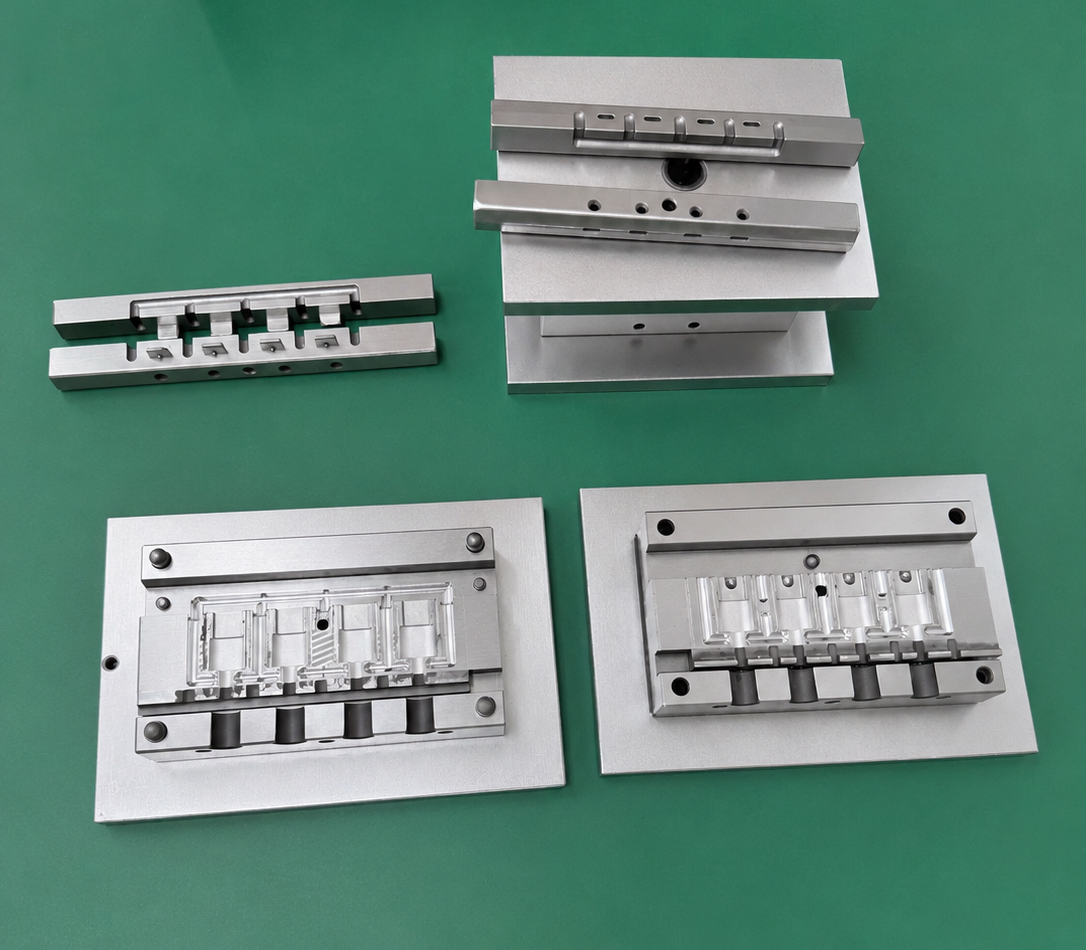
A data cable mold is a special mold used for injection molding the plug housing, strain relief, SR anti-bending structure, overmolded housing, and other parts of a data cable. It is usually used together with a vertical injection molding machine. Plastic materials such as PVC, TPE, TPU, ABS, and PC are injected around USB terminals, Type-C terminals, Lightning terminals, or cable connection areas to form a complete cable plug structure.
In simple terms, a data cable mold determines the appearance, dimensional accuracy, grip feel, bending resistance, and mass production consistency of the cable plug.
For example, for the same Type-C cable, if the mold has high precision, the plug overmolding will be fuller, the metal connector will be more centered, the strain relief transition will be smoother, and the overall appearance will look more refined. If the mold quality is poor, the product may have problems such as crooked plugs, rough housing surfaces, obvious parting lines, unsmooth strain relief, and excessive flash.
Therefore, a data cable mold is not simply a tool for making an outer shell shape. It is a basic production tool that affects product structure, appearance, production efficiency, and long-term quality stability.
二、Main Types of Data Cable Molds
Data cable molds can be classified according to connector type, structural position, and customization level. Common types include USB-A plug molds, Type-C plug molds, Lightning plug molds, Micro USB plug molds, strain relief molds, and private custom molds.
1. USB-A Plug Mold
USB-A is one of the most common connectors used in traditional data cables. It is widely used in chargers, computers, car chargers, power strips, power banks, and other devices. USB-A plug molds are mainly used to form the USB-A plug housing, strain relief, and anti-bending structure.
This type of mold has a relatively mature structure and lower cost. It is suitable for mass production of standard charging cables, fast charging cables, promotional cables, and regular electronic accessory cables.
2. Type-C Plug Mold
Type-C cables are currently the mainstream in the market and are widely used in Android phones, tablets, laptops, power banks, car devices, and smart hardware products.
The Type-C connector is small, so it requires higher mold precision. A Type-C mold should focus on whether the plug overmolding is full, whether the metal connector is centered, and whether the strain relief is smooth and natural. If the mold positioning is inaccurate, problems such as connector misalignment, uneven overmolding, crooked plugs, and obvious parting lines may occur.
For mid-to-high-end fast charging cables, the quality of the Type-C plug mold directly affects the product appearance and customer experience.
3. Lightning Plug Mold
Lightning cables are mainly used for Apple devices. The Lightning plug has a small structure and high appearance requirements, especially for the white plastic area, metal connector, tail overmolding, and overall detail finishing.
If customers make Apple-compatible cables, white high-end cables, or brand-customized cables, the precision of the Lightning plug mold and the injection molding process are very important. A good mold can make the plug appearance cleaner, the dimensions more stable, and the plugging experience better.
4. Micro USB Plug Mold
Although Micro USB is no longer the mainstream interface for new mobile devices, it is still used in small household appliances, Bluetooth speakers, toys, flashlights, older Android devices, electronic gifts, and other products.
Micro USB molds usually cost less than Type-C and Lightning molds. They are suitable for price-sensitive products, traditional device accessory cables, and standard charging cable production.
5. Strain Relief / SR Anti-Bending Mold
Strain relief molds are mainly used for the anti-bending structure at the rear end of the cable plug. The most easily damaged part of a data cable is usually the connection between the plug and the cable body, so strain relief design is very important.
A good strain relief design can improve bending resistance and reduce problems such as plug tail cracking, inner wire breakage, and poor contact. Mid-to-high-end data cables often use differentiated strain relief designs, such as extended strain relief, stepped strain relief, rounded transition strain relief, soft anti-bending strain relief, and two-color overmolded strain relief.
6. Private Mold / Custom Appearance Mold
If customers want their cable appearance to be different from common market models, such as special aluminum housings, unique strain relief designs, brand LOGO structures, angled plugs, gaming cable styles, or multi-in-one adapter cables, a private mold is required.
The advantage of a private mold is strong product differentiation, which helps avoid homogeneous competition. It is more suitable for brand customers, e-commerce customers, and long-term sales products. The disadvantage is that the development cost is higher, and design drawings, structural drawings, sample testing, and mass production verification are required in the early stage.
三、Common Materials and Selection Requirements for Data Cable Molds
The material of a data cable mold mainly refers to the steel used for the mold itself. Different mold steels have different hardness, wear resistance, polishing performance, corrosion resistance, and service life. These factors directly affect the appearance, dimensional stability, and mass production yield of the injected cable plug.
Although data cable molds are small, their structures are relatively precise. Type-C plugs, Lightning plugs, strain relief, and anti-bending structures require high mold machining accuracy and stable steel performance. If the mold steel is not selected properly, problems such as flash, shrinkage, deformation, obvious parting lines, rough surfaces, and fast mold wear may occur during production.
1. Common Steel Materials for Data Cable Molds
Common steel materials for data cable molds include P20, 718, NAK80, S136, and H13. Different steels are suitable for different product positioning and injection molding materials.
P20 Mold Steel
P20 is a common pre-hardened mold steel. It is relatively economical and has good machinability. It is suitable for standard data cable plug molds, USB-A plug molds, Micro USB plug molds, and ordinary PVC overmolding molds.
If customers produce ordinary charging cables, promotional data cables, or low-cost USB cables, and the order quantity is not very large or the appearance requirements are not very high, P20 mold steel can usually meet basic production needs.
718 Mold Steel
718 mold steel has better stability, polishing performance, and wear resistance than ordinary P20. It is suitable for mid-range data cable molds, Type-C plug molds, Lightning plug molds, and TPE / TPU overmolding molds.
For most mid-range custom data cable orders, 718 mold steel is a reliable choice. It helps control mold costs while ensuring good injection molding results.
NAK80 Mold Steel
NAK80 is a high-polishing pre-hardened steel with good surface finish and strong dimensional stability. It is suitable for data cable plug molds with high appearance requirements, such as glossy housings, high-end Type-C plugs, brand-customized cable plugs, and overmolded parts requiring a delicate surface finish.
S136 Mold Steel
S136 has good corrosion resistance, polishing performance, and wear resistance. It is suitable for molds that require high appearance quality, transparency, and corrosion resistance. For example, transparent plastic housings, light-colored glossy cable plugs, and molds used for long-term injection of corrosive materials can consider S136.
H13 Mold Steel
H13 has good heat resistance and hot strength. It is often used in high-temperature, high-pressure, or high-wear mold applications. It is not commonly used in standard data cable plug injection molding, but it can be considered for special engineering plastics or complex high-strength mold structures.
2. Mold Material Selection Based on Different Injection Materials
Common injection materials for data cable plugs include PVC, TPE, TPU, ABS, PC, and silicone. Different plastic materials have different flow properties, shrinkage rates, corrosiveness, molding temperatures, and demolding difficulties. Therefore, mold steel and structural design should be adjusted accordingly.
PVC Material Mold Requirements
PVC is a common overmolding material for ordinary data cables. It is low-cost, stable in molding, and suitable for standard charging cables, promotional cables, and low-cost data cables.
For ordinary PVC data cable plug molds, P20 or 718 steel can be used. The mold should have good venting design to avoid trapped air, burning marks, and gas marks. For long-term PVC production, it is recommended to use steel with better corrosion resistance or apply anti-corrosion treatment to the mold surface.
TPE Material Mold Requirements
TPE has a soft feel and good elasticity. It is often used in mid-to-high-end data cables, fast charging cables, and brand-customized cables.
For TPE data cable plug molds, 718, NAK80, or S136 is recommended. The mold design should pay attention to shrinkage control, strain relief transition, demolding difficulty, surface texture depth, gate position, and weld lines.
TPU Material Mold Requirements
TPU has good wear resistance, tensile strength, and elasticity. It is suitable for durable data cables, high-end fast charging cables, reinforced cables, and industrial device connection cables.
For TPU molds, 718, NAK80, or S136 is recommended. The mold should have good venting, sufficient draft angle, reasonable gate size, and a smooth mold surface to avoid sticking.
ABS Material Mold Requirements
ABS is often used for hard housings, decorative shells, outer plug housings, and similar structures. For ABS data cable plug housings or hard decorative parts, P20, 718, and NAK80 can all be used.
If the appearance requirements are higher, such as glossy surfaces, spray painting, pre-electroplating treatment, or branded housing parts, NAK80 or S136 can be selected.
PC Material Mold Requirements
PC has high strength and good impact resistance. It is suitable for hard plug housings, transparent parts, or special structural parts that require higher strength.
For PC molds, 718, NAK80, or S136 is recommended. If the product is a transparent PC housing or a high-gloss product, S136 is preferred because it has better polishing performance and corrosion resistance.
Silicone Material Mold Requirements
Silicone data cables are generally used for high-end cables or special products that require a very soft feel. Silicone molding processes are different from ordinary PVC, TPE, and TPU molding. They have more special requirements for mold structure, venting, temperature control, and demolding.
For silicone products with high appearance requirements and long-term production needs, mold steel with good wear resistance, corrosion resistance, and polishing performance is recommended.
3. Mold Material Selection Based on Appearance Requirements
For ordinary matte data cable plugs, P20 or 718 can usually meet the requirements.
For glossy plugs, high-gloss housings, or brand-customized appearances, NAK80 or S136 is recommended because they provide better polishing performance and a more delicate product surface.
For transparent or semi-transparent housings, S136 is recommended because transparent parts require high mold surface finish.
For light-colored cables, such as white, beige, and light gray products, mold steel with better polishing performance and surface stability is recommended because light-colored products are more likely to show gas marks, black spots, burning marks, and parting lines.
For long-term mass production, 718, NAK80, or S136 is recommended. It is not advisable to choose low-grade steel only to save mold costs, because mold wear will increase repair costs and affect product yield later.
4. Key Points in Data Cable Mold Design
Gate position affects plastic flow direction, product appearance, shrinkage position, and weld line position. Since the appearance area of a cable plug is small, unreasonable gate design may cause obvious flow marks, incomplete filling, shrinkage, or gate marks.
Venting design is very important. Cable plugs are small but have fine structures, especially the strain relief, anti-bending area, and terminal overmolding area, where trapped air can easily occur.
Parting line position directly affects product appearance. A good mold design will place the parting line in a less visible position as much as possible and control parting accuracy to reduce flash and burrs.
Draft angle must also be reasonable. Strain relief, anti-bending structures, and plug housings often have fine textures and stepped structures. If the draft angle is insufficient, the product may be scratched, deformed, or stuck in the mold.
Shrinkage control should be considered according to material characteristics in advance. Different plastic materials have different shrinkage rates.
Terminal positioning structure is also critical. USB-A, Type-C, Lightning, and other terminals must be accurately fixed during injection molding.
四、Main Types of Data Cable Mold Manufacturers
Manufacturers that make data cable molds can generally be divided into two types: professional mold manufacturers and data cable source factories. Customers should choose according to whether they already have drawings, whether they need samples, and whether they need subsequent mass production.
1. Professional Mold Manufacturers
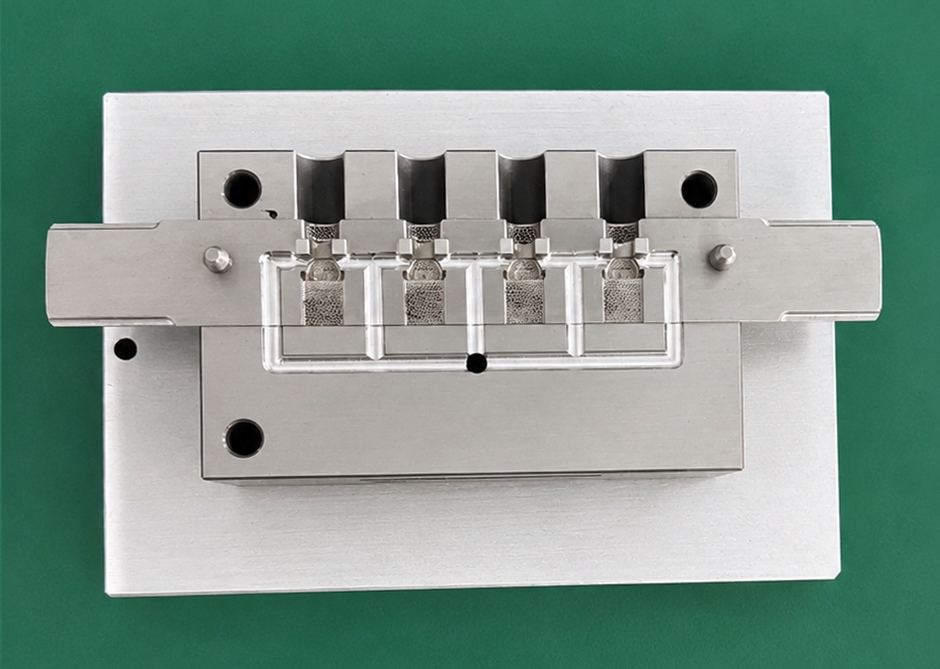
Professional mold manufacturers mainly develop and process data cable plug housing molds, USB plug molds, Type-C plug molds, Lightning plug molds, strain relief molds, and overmolding molds. These manufacturers usually have CNC machining, EDM, wire cutting, grinding, polishing, assembly, and mold trial capabilities.
The biggest advantage of professional mold manufacturers is rich processing experience and relatively better mold precision. They can design molds according to the product structure, such as overmolding position, strain relief bending angle, metal connector positioning, parting line position, gate position, and venting position.
In terms of industrial distribution in China, professional mold manufacturers are mainly concentrated in the Pearl River Delta and Yangtze River Delta regions.
Shenzhen, Dongguan, Huizhou, Zhongshan, and other cities in Guangdong are close to the electronics, connector, data cable, charger, and consumer electronics supply chains. These areas are suitable for finding USB data cable molds, Type-C plug molds, and charging cable overmolding molds.
When judging which mold manufacturers have a good reputation, customers should focus on whether the manufacturer has long-term experience in small precision molds, whether it has real cases, whether it can provide mold trial services, whether it is willing to adjust molds according to production problems, and whether it has stable customers and industry reputation.
2. Data Cable Source Factories
Data cable source factories produce USB cables, Type-C cables, Lightning cables, Micro USB cables, fast charging cables, and other products themselves. They also usually have certain capabilities in mold development, structural design, injection molding, and mass production.
These factories may not be as specialized in mold processing as professional mold manufacturers, but they understand data cable products better. For example, they know how to choose wire specifications, match terminals, determine plug overmolding thickness, design strain relief length, pass bending tests, and control finished product defect rates.
For foreign trade customers, e-commerce customers, promotional gift customers, and brand customization customers, choosing a data cable source factory is more convenient. Customers do not need to separately contact a mold factory, wire factory, injection molding factory, assembly factory, and packaging factory.
If the order quantity is large, data cable source factories may also provide free mold opening, mold cost reduction, or mold cost refund solutions.
五、How to Judge the Quality of a Data Cable Mold
1. Check Whether the Product Appearance Is Clean
A plug housing produced by a good mold should have a flat surface, smooth edges, and no obvious flash, shrinkage, incomplete filling, gas marks, burning marks, or heavy parting lines.
2. Check Whether the Dimensions Are Stable
Type-C, Lightning, USB-A, and other connectors all have fixed structures. Unstable mold dimensions will affect plug-in feel, assembly accuracy, and product consistency.
3. Check the Strain Relief Anti-Bending Effect
The most easily damaged part of a data cable is usually the plug tail. A high-quality mold will create a natural transition between the strain relief and the cable body.
4. Check Mold Service Life
Ordinary sample molds are suitable for small-batch testing, but for long-term mass production, a more durable production mold is required.
5. Check Trial Production Defect Rate
A truly good mold does not only produce one good-looking sample. It should also remain stable during mass production.
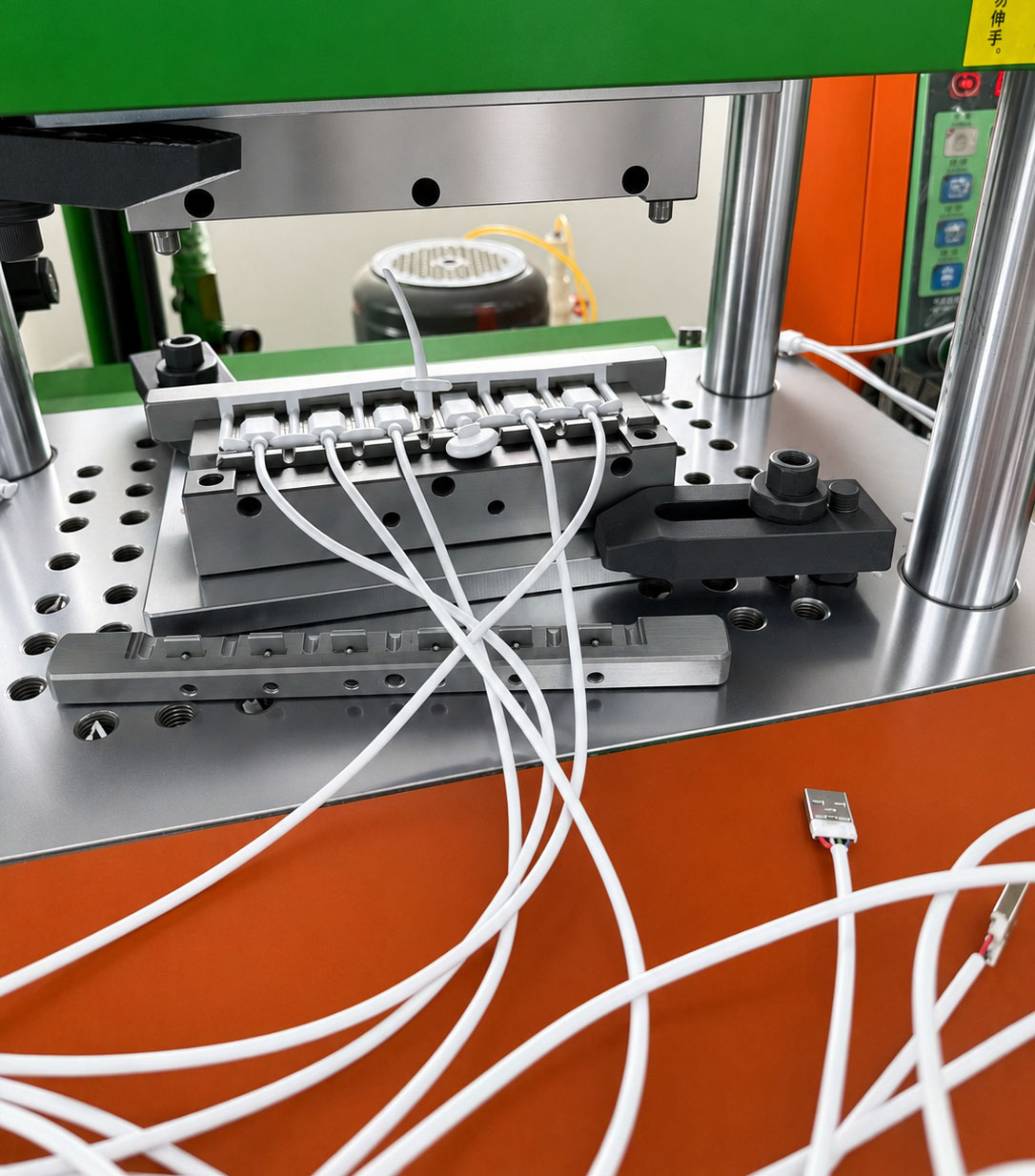
六、How Much Does a Data Cable Mold Usually Cost?
The price of a data cable mold is affected by many factors, including connector type, mold structure, number of cavities, mold steel, injection material, precision requirements, whether it is a private mold, whether two-color injection molding is required, whether it includes a LOGO, and whether it has a special appearance design.
| Mold Type | Reference Price Range | Suitable Applications |
|---|---|---|
| Simple sample mold | Several hundred to about 1,000–2,000 RMB | Sampling and small-batch verification |
| Standard USB / Micro USB mold | About 1,000–3,000 RMB | Regular data cable production |
| Type-C / Lightning plug mold | About 2,000–6,000 RMB | Mid-to-high-end data cable customization |
| Multi-cavity production mold | About 5,000–10,000 RMB or more | Mass production |
| Private mold / special structure mold | About 8,000 RMB to tens of thousands of RMB | Brand customization and differentiated products |
The above prices are only rough references. The actual quotation should be confirmed according to drawings, structure, materials, quantity, and quality requirements.
七、Why Do Mold Prices Vary So Much Between Manufacturers?
First, mold materials are different. Ordinary steel and high-quality mold steel have different costs and service lives.
Second, machining precision is different. Precision CNC, slow wire cutting, EDM, polishing, and other processing requirements increase the cost.
Third, the number of cavities is different. One-cavity, two-cavity, four-cavity, and eight-cavity molds have different production efficiencies, complexity, and prices.
Fourth, injection materials are different. PVC, TPE, TPU, silicone, PC, ABS, and other materials have different molding requirements.
Fifth, design services may or may not be included. Some manufacturers only process molds, while others provide structural design, 3D drawings, mold trials, sample confirmation, and mass production optimization.
Sixth, later production may or may not be included. If customers directly work with a finished data cable factory, some factories may reduce the mold cost or even provide free mold opening based on order quantity.
八、How to Choose a Data Cable Mold Manufacturer
1. Whether the Manufacturer Understands Data Cable Structure
A data cable mold is not an ordinary plastic housing mold. It involves terminals, wires, solder joints, strain relief, overmolding, plug-in feel, and bending life.
2. Whether Sample Confirmation Is Available
A reliable manufacturer usually confirms drawings according to customer requirements first, then arranges mold opening, trial molding, and sample confirmation.
3. Whether the Manufacturer Has Injection Molding and Production Experience
If the manufacturer has data cable production capability, it can directly verify the mold performance in real production.
4. Whether OEM/ODM Customization Is Supported
For brand customers, e-commerce customers, and foreign trade customers, OEM/ODM capability is important.
5. Whether Mold Cost Can Be Reduced Based on Order Quantity
If the order quantity is large, customers can give priority to manufacturers that support free mold opening, mold cost reduction, or mold cost refund.
九、Common Process for Custom Data Cable Mold Development
- The customer provides product images, samples, or design requirements.
- The manufacturer evaluates the structure and production feasibility.
- Connector type, wire specifications, appearance size, and materials are confirmed.
- The manufacturer provides a quotation and mold solution.
- Mold opening begins after drawing confirmation.
- Mold trial and sample production are arranged.
- The customer confirms the sample.
- Small-batch trial production is conducted.
- Mass production and quality inspection are completed.
十、Data Cable Mold Customization Advantages of Yangjiang Huchuang Electronics Co., Ltd.
Yangjiang Huchuang Electronics Co., Ltd. is a professional data cable factory that mainly produces USB cables, Type-C cables, Lightning cables, Micro USB cables, fast charging cables, and other products. It can provide OEM/ODM customization services according to customer needs.
For customers who need custom data cables, choosing a finished data cable factory has clear advantages. It can not only support mold development, but also complete wire selection, terminal matching, injection molding, finished product testing, and packaging shipment at the same time.
Yangjiang Huchuang Electronics Co., Ltd. can provide different material and structural solutions according to customer product positioning, such as standard PVC cable solutions, soft TPE fast charging cable solutions, nylon braided cable solutions, and aluminum housing solutions.
If the customer’s order quantity reaches a certain scale, they can also discuss mold cost reduction, free mold opening, or mold cost refund solutions with the factory, thereby reducing early-stage development costs.
十一、Conclusion
Although data cable molds are only one part of data cable production, they directly affect product appearance, structural strength, production efficiency, and customer experience. Standard data cables can use common molds to reduce costs, while mid-to-high-end data cables, brand-customized cables, and special-structure cables are more suitable for exclusive mold development.
When choosing a data cable mold, customers should not only focus on the mold opening price. They should also consider mold steel, structural design, injection materials, product appearance requirements, and order quantity.
In terms of manufacturer selection, professional mold manufacturers are suitable for customers who have drawings, engineering capability, and only need separate mold development. Data cable source factories are more suitable for customers who want one-stop product development, sampling, production, testing, and packaging.
For customers with long-term customization needs, choosing a source factory that understands both molds and data cable production is more convenient than separately looking for a mold manufacturer. It also helps control costs, improve quality, and shorten delivery time.